For years, military recruitment in the United Kingdom followed a predictable pattern. Applications fluctuated, targets rose and fell, but the overall structure of the Armed Forces remained relatively stable. That stability has now disappeared.
Behind official statements about “modernisation” and “streamlined recruitment” sits a more difficult reality: the British military is struggling to recruit and retain personnel at the levels it needs. The numbers published by the Ministry of Defence over the past 18 months paint a picture of a system under pressure — one where the Defence Aptitude Assessment (DAA) has become increasingly important in determining who progresses into specialist roles.
At first glance, recent statistics appear encouraging. Recruitment figures have improved compared with previous years, and intake numbers are beginning to recover. But dig deeper into the data and another story emerges. Despite increased applications, the Armed Forces are still shrinking overall. More people are joining, yet not enough are staying.
For applicants preparing to sit the DAA, these figures matter more than they might realise.
The British Army Is Still Below Strength
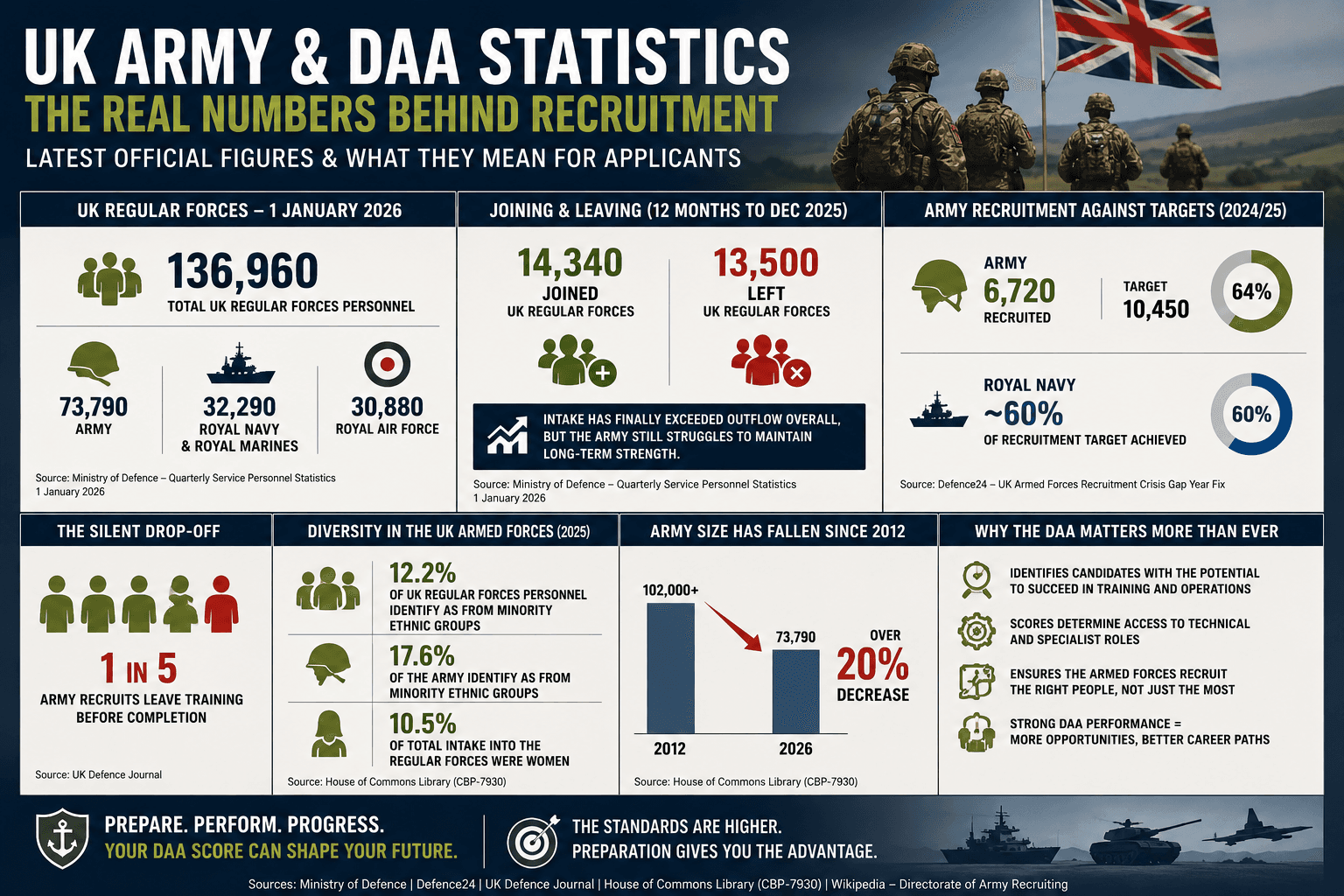
According to the latest Ministry of Defence personnel statistics, the UK Regular Forces stood at approximately 136,960 personnel at the beginning of 2026. Of those, the Army accounted for roughly 73,790 personnel, while the Royal Navy and Royal Marines stood at just over 32,000 (https://www.gov.uk/government/statistics/quarterly-service-personnel-statistics-2026/quarterly-service-personnel-statistics-1-january-2026).
The issue is not simply size — it is sustainability.
In the 12 months leading to December 2025, around 14,340 people joined the UK Regular Forces, while 13,500 left. Although intake has finally begun to exceed outflow overall, the Army itself continues to struggle to maintain long-term strength (https://www.gov.uk/government/statistics/quarterly-service-personnel-statistics-2026/quarterly-service-personnel-statistics-1-january-2026).
That trend has been developing for years. Since 2012, the total size of the UK Armed Forces has fallen by more than 20%, with the Army experiencing the sharpest reduction (https://researchbriefings.files.parliament.uk/documents/CBP-7930/CBP-7930.pdf).
The challenge facing recruiters is no longer simply attracting applicants. It is identifying candidates capable of completing training, progressing into technical roles, and remaining in service long enough to justify the investment.
This is where the DAA enters the picture.
Why the DAA Has Become More Important
The Defence Aptitude Assessment is often viewed by applicants as just another stage of recruitment. In reality, it has become one of the military’s primary filtering tools.
The Armed Forces are increasingly focused on technical capability. Modern military operations depend heavily on engineering, communications systems, cyber operations, and advanced equipment. As roles become more specialised, the need for candidates who can process information quickly and adapt under pressure becomes far greater.
The DAA is designed to identify exactly those traits.
While official pass-rate figures for the DAA are not publicly released in full, recruitment data strongly suggests that aptitude testing now plays a more significant role than at any point in recent years. Candidates who achieve stronger scores gain access to technical and specialist branches, while lower scores can severely limit career options.
In practical terms, the DAA no longer acts simply as an entry test. It functions as a sorting mechanism for the modern Armed Forces.
The Recruitment Crisis Few Expected
The scale of Britain’s recruitment difficulties became increasingly visible throughout 2024 and 2025.
According to defence reporting based on Ministry of Defence figures, the Army recruited approximately 6,720 personnel against a target of 10,450, reaching only around 64% of its recruitment goal. The Royal Navy performed similarly, achieving roughly 60% of its target intake (https://defence24.com/armed-forces/uk-armed-forces-recruitment-crisis-gap-year-fix).
This shortfall has forced military planners to rethink recruitment entirely.
Historically, the challenge was attracting enough interest. Today, applications are not the main problem. In fact, Army applications reportedly rose by more than 40% during parts of 2025 (https://www.thetimes.co.uk/article/mod-figures-show-armed-forces-still-shrinking-despite-recruitment-drive-dbl3bphpj).
The difficulty lies in conversion.
Large numbers begin the recruitment process, but far fewer progress through medical checks, aptitude assessments, fitness standards, interviews, and training pipelines. By the time candidates reach Phase 1 training, the pool has narrowed dramatically.
That makes every stage of selection more significant — especially the DAA.
The Silent Drop-Off During Training
Passing the aptitude test is only one part of the process.
Across the Armed Forces, a substantial proportion of recruits fail to complete initial training. While exact yearly percentages fluctuate, reports indicate that around one in five Army recruits historically leave training before completion (https://www.facebook.com/ukdefencejournal/posts/the-proportion-of-british-army-recruits-failing-to-complete-initial-training-has/1347214237451836/).
This creates a costly cycle for the military. Recruiting and training personnel requires major investment, and each unsuccessful recruit represents lost time, funding, and operational planning.
As a result, recruitment systems increasingly prioritise identifying applicants who demonstrate long-term potential rather than simply meeting minimum standards.
The DAA contributes heavily to that assessment because it reveals how candidates perform under pressure, how quickly they process information, and how effectively they maintain concentration.
In other words, it provides insight into trainability.
Technical Roles Are Driving Recruitment
One of the clearest trends in modern military recruitment is the growing demand for technically capable personnel.
Engineering branches, communications specialists, aircraft technicians, and cyber-focused roles now occupy a much larger portion of recruitment planning than they did a decade ago.
These roles require stronger performance in areas such as numerical reasoning, mechanical comprehension, spatial awareness, and work rate accuracy.
Candidates hoping to access these career paths increasingly need higher DAA scores than applicants entering non-technical branches.
This has changed how many recruiters approach selection. High-performing candidates are viewed not simply as successful applicants, but as strategically valuable personnel.
Diversity and Changing Recruitment Demographics
Recent government statistics also reveal major shifts in the composition of the Armed Forces.
As of 2025:
- Around 12.2% of UK Regular Forces personnel identified as belonging to minority ethnic groups
- The Army had the highest proportion at 17.6%
- Women accounted for approximately 10.5% of total intake into the Regular Forces
(https://researchbriefings.files.parliament.uk/documents/CBP-7930/CBP-7930.pdf)
The Ministry of Defence has repeatedly stated its intention to widen participation across the services, particularly in technical and leadership pathways.
This broader recruitment approach has also increased focus on aptitude-based selection rather than purely traditional educational backgrounds.
The DAA supports this shift because it measures applied reasoning ability directly, rather than relying solely on academic qualifications.
Why Applicants Should Pay Attention to These Numbers
For candidates preparing to join the Armed Forces, these statistics are more than background information. They reveal how competitive recruitment has become — and where opportunities now exist.
The military urgently needs capable recruits, particularly in specialist and technical areas. However, it also faces significant pressure to reduce training failures and improve long-term retention.
That means preparation matters.
Candidates who arrive prepared for the DAA place themselves in a much stronger position than those relying on natural ability alone. Strong scores expand role eligibility, improve competitiveness, and demonstrate the type of potential recruiters are actively searching for.
In a shrinking military, quality matters more than ever.
The Shift Towards Faster Recruitment
Another major issue affecting the Armed Forces has been the speed of recruitment itself.
For years, applicants complained about long waiting times between application stages. Delays sometimes stretched into months, causing many candidates to abandon the process entirely.
In response, the Ministry of Defence has begun restructuring recruitment systems to simplify entry pathways and reduce administrative delays. New systems are expected to continue rolling out over the coming years (https://en.wikipedia.org/wiki/Directorate_of_Army_Recruiting).
The aim is clear: reduce friction, improve candidate retention, and move stronger applicants through the process more efficiently.
This shift could ultimately place even greater emphasis on early assessment stages such as the DAA, since faster recruitment systems rely heavily on effective initial screening.
What These Statistics Mean for the Future
The British military is entering a period of significant transition.
Personnel numbers remain below historic levels. Recruitment targets continue to be difficult to meet. At the same time, operational demands are becoming more technologically complex.
As a result, the qualities being prioritised in recruits are changing.
The modern Armed Forces are looking for individuals who can learn quickly, adapt under pressure, handle technical information, and maintain accuracy at speed.
These are precisely the skills measured within the Defence Aptitude Assessment.
For applicants, this creates both a challenge and an opportunity.
The challenge is obvious: competition for desirable roles remains high, and the standards for technical positions are increasing.
The opportunity is equally clear. Candidates who prepare properly for the DAA can place themselves ahead of a large proportion of the applicant pool before recruitment has even fully begun.
Final Thoughts
The numbers emerging from official military statistics reveal a recruitment system under pressure but also one evolving rapidly.
Britain’s Armed Forces are no longer simply trying to increase applicant numbers. They are trying to recruit the right people — candidates capable of succeeding in highly technical, fast-moving environments.
That is why the DAA matters more than ever.
For applicants, understanding this broader context changes the way the assessment should be approached. It is not merely a test to pass. It is one of the most important indicators recruiters use to decide where you fit within the modern military.
And in a recruitment environment where every capable candidate matters, preparation has become one of the strongest advantages an applicant can have.