The Defence Aptitude Assessment (DAA) has become one of the most decisive stages in the UK armed forces recruitment process. Whether you are aiming for the Royal Navy, the Royal Air Force, or specific Army roles, your performance in this assessment does more than determine entry—it shapes the opportunities available to you from the outset.
In 2026, the DAA is no longer simply a screening tool. It is a performance benchmark used to align candidates with roles that demand precision, speed, and practical reasoning. Recruiters are not just asking whether you can pass. They are assessing how you think.
A Shift in Recruitment Standards
Recent updates across UK defence recruitment—particularly within the RAF and Royal Navy—show a clear shift toward cognitive performance under pressure. Official guidance emphasises that modern roles require fast decision-making, adaptability, and the ability to process technical information quickly.
This is reflected directly in the DAA.
The test itself has not dramatically changed in structure, but expectations have. Candidates are now competing not just to meet minimum thresholds, but to exceed them in order to access higher-skilled and more technical roles.
What the DAA Actually Measures
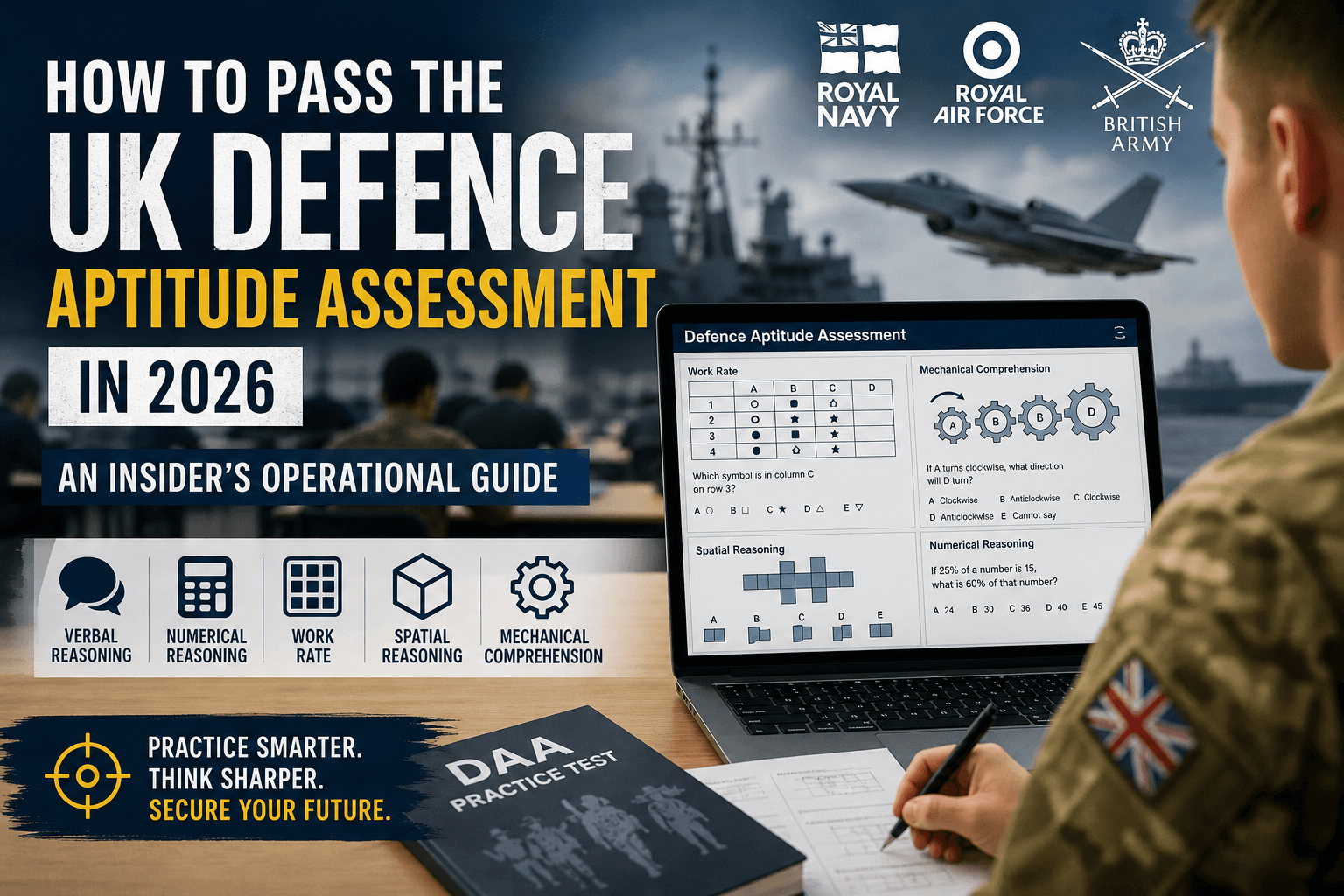
At first glance, the DAA appears to be a mixture of standard aptitude questions. In reality, each section is designed to assess a specific operational skill.
Verbal reasoning tests your ability to interpret written information quickly and accurately—essential for following instructions and processing communication in real time.
Numerical reasoning focuses on practical maths. You are not expected to perform complex calculations, but you must be confident with percentages, ratios, and basic arithmetic under time pressure.
Work rate is where many candidates are caught off guard. This section measures how efficiently you can process repetitive information while maintaining accuracy. It reflects real-world scenarios where sustained focus is critical.
Spatial reasoning assesses your ability to visualise objects and understand how parts fit together. This is particularly relevant in engineering, aviation, and technical trades.
Mechanical comprehension evaluates your understanding of basic physical principles. This includes gears, levers, pulleys, and tools—knowledge that underpins a wide range of military roles.
The Mechanical Comprehension Reality
Contrary to popular belief, this section does not require an engineering background. The questions are grounded in everyday logic rather than technical theory.
Candidates who struggle here often do so because they overcomplicate simple concepts.
If two gears are connected, they will rotate in opposite directions. This principle does not change, regardless of size. Each additional gear reverses the direction again. It is a simple rule, but under timed conditions, many candidates second-guess themselves.
The same applies to levers and pulleys. A longer lever arm produces greater force. A fixed pulley changes direction, not effort. These are not abstract ideas—they are practical observations.
Tool identification is another overlooked area. You may be shown a diagram or description and asked to identify the correct tool. Understanding what a spanner, vice, or clamp is used for can make the difference between an average and a strong score.
Spatial Reasoning: Precision Over Guesswork
Spatial reasoning is often underestimated because the questions appear straightforward. In practice, this section requires disciplined thinking.
When matching shapes, the key is not to visualise the final object immediately. Instead, focus on the edges. Only edges of equal length can join. If two sides do not match, the connection is impossible.
This approach reduces guesswork and speeds up decision-making. Candidates who rely purely on visual imagination tend to lose time and accuracy.
Work Rate: Managing Pressure and Rhythm
The work rate section is less about intelligence and more about control.
You are presented with grids linking letters, numbers, and symbols. The task is repetitive, but the time pressure is intense. The challenge is to maintain a steady rhythm without slowing down or making careless mistakes.
Candidates often fail here because they hesitate. They double-check answers excessively or lose focus after a single error. In reality, this section rewards momentum. Once you establish a pattern, you must trust it.
RAF and Royal Navy Expectations
Based on current recruitment guidance, both the RAF and Royal Navy are placing increased emphasis on cognitive performance.
The RAF, particularly in technical and aircrew roles, expects strong results in spatial reasoning and mechanical comprehension. These roles require rapid interpretation of visual and technical data.
The Royal Navy focuses heavily on practical reasoning and consistency. Mechanical understanding and work rate performance are key indicators of suitability for engineering and operational roles.
Meeting the minimum score is no longer sufficient for competitive positions. Strong candidates demonstrate balanced performance across all sections.
Training for the DAA: A Practical Approach
Preparation for the DAA should reflect the conditions of the test itself. This means training under time pressure from the beginning.
Short, focused sessions are more effective than long, unfocused revision. Ten to fifteen minutes of high-intensity practice can produce better results than an hour of passive study.
It is also essential to address weaknesses directly. Many candidates spend too much time reinforcing areas they are already comfortable with. Progress comes from improving weaker sections, particularly mechanical comprehension and work rate.
Pattern recognition plays a crucial role. While the exact questions will differ, the underlying logic remains consistent. Learning to identify these patterns allows you to respond more quickly and confidently.
The Importance of Mental Resilience
The DAA is as much a psychological test as it is an academic one.
You will make mistakes. The key is how quickly you recover. Dwelling on a single error can disrupt your performance across an entire section.
Maintaining focus, controlling nerves, and sustaining effort under pressure are all part of the assessment. These are the same qualities expected in operational environments.
A Realistic Perspective on Results
If you do not achieve the score required for your chosen role, there may be an opportunity to retake the assessment after a waiting period. However, this should not be part of your plan.
Your first attempt carries weight. A strong performance opens doors to a wider range of roles, particularly in technical fields.
Preparation is not about simply passing. It is about positioning yourself for the best possible outcome.
Final Word
The Defence Aptitude Assessment is your introduction to military thinking. It tests how you process information, how you respond under pressure, and how you apply practical reasoning.
Success does not come from memorising answers. It comes from understanding the principles behind the questions and applying them consistently.
Those who approach the DAA with discipline, focus, and the right preparation stand out immediately.
If you are serious about improving your performance and accessing the most competitive roles, structured practice is essential. Resources designed specifically for UK defence applicants can make a measurable difference.
You can find targeted preparation materials, realistic practice questions, and module-specific training at: