What Is the Royal Navy Defence Aptitude Assessment?
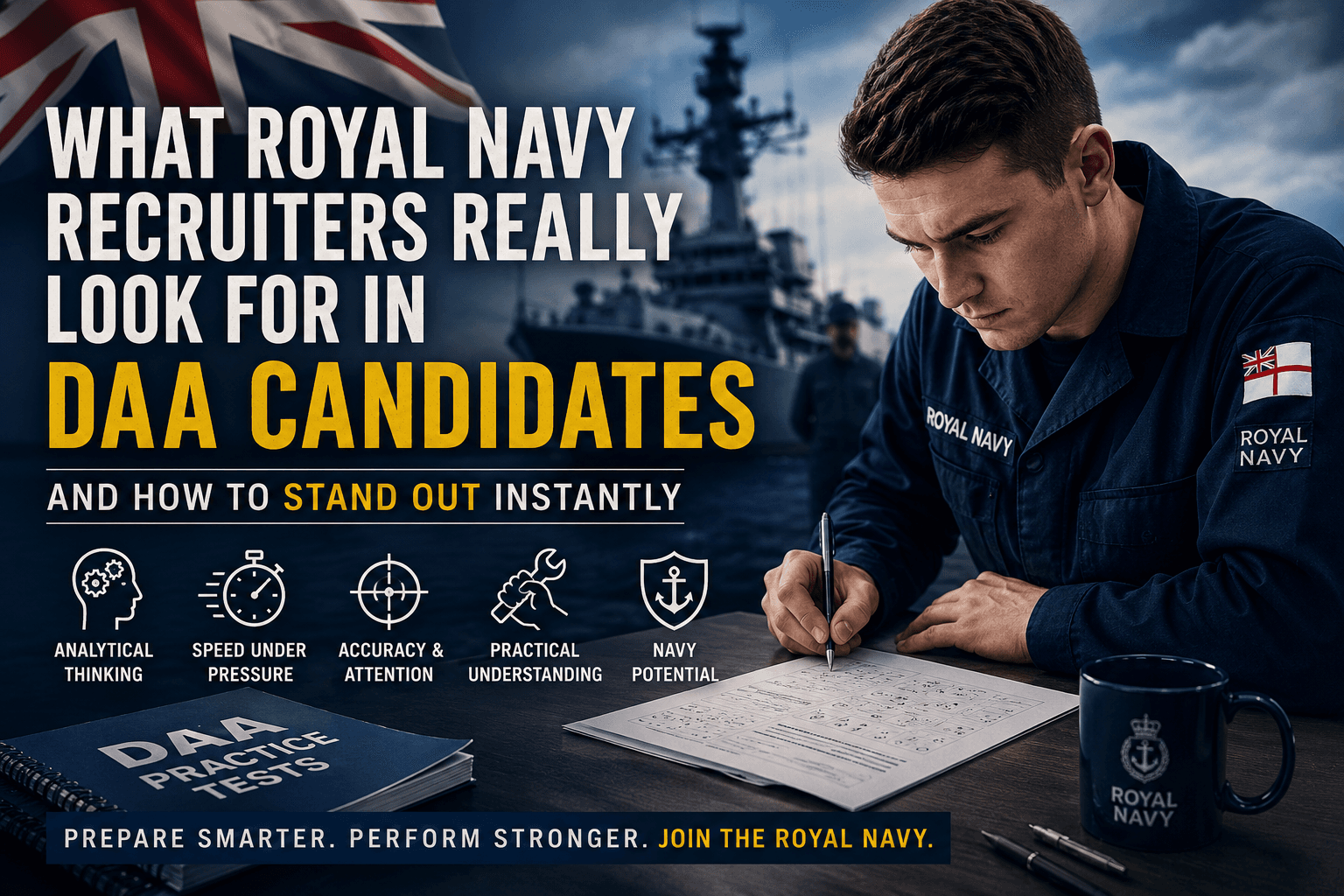
The Defence Aptitude Assessment (DAA) is a computer-based psychometric test used to measure the core abilities required for service in the Royal Navy.
It evaluates how well you can:
- Process information quickly
- Solve problems under time pressure
- Understand technical and mechanical concepts
- Interpret written and numerical information
The test is normally completed during your recruitment process through the Armed Forces Careers Office (AFCO) or via the official online testing system.
Your result determines:
- Whether you meet the minimum entry standard
- Which Royal Navy branches you qualify for
- How competitive your application is compared to other candidates
For this reason, many applicants prepare using Royal Navy aptitude test practice questions before taking the assessment.
Sections of the Royal Navy DAA
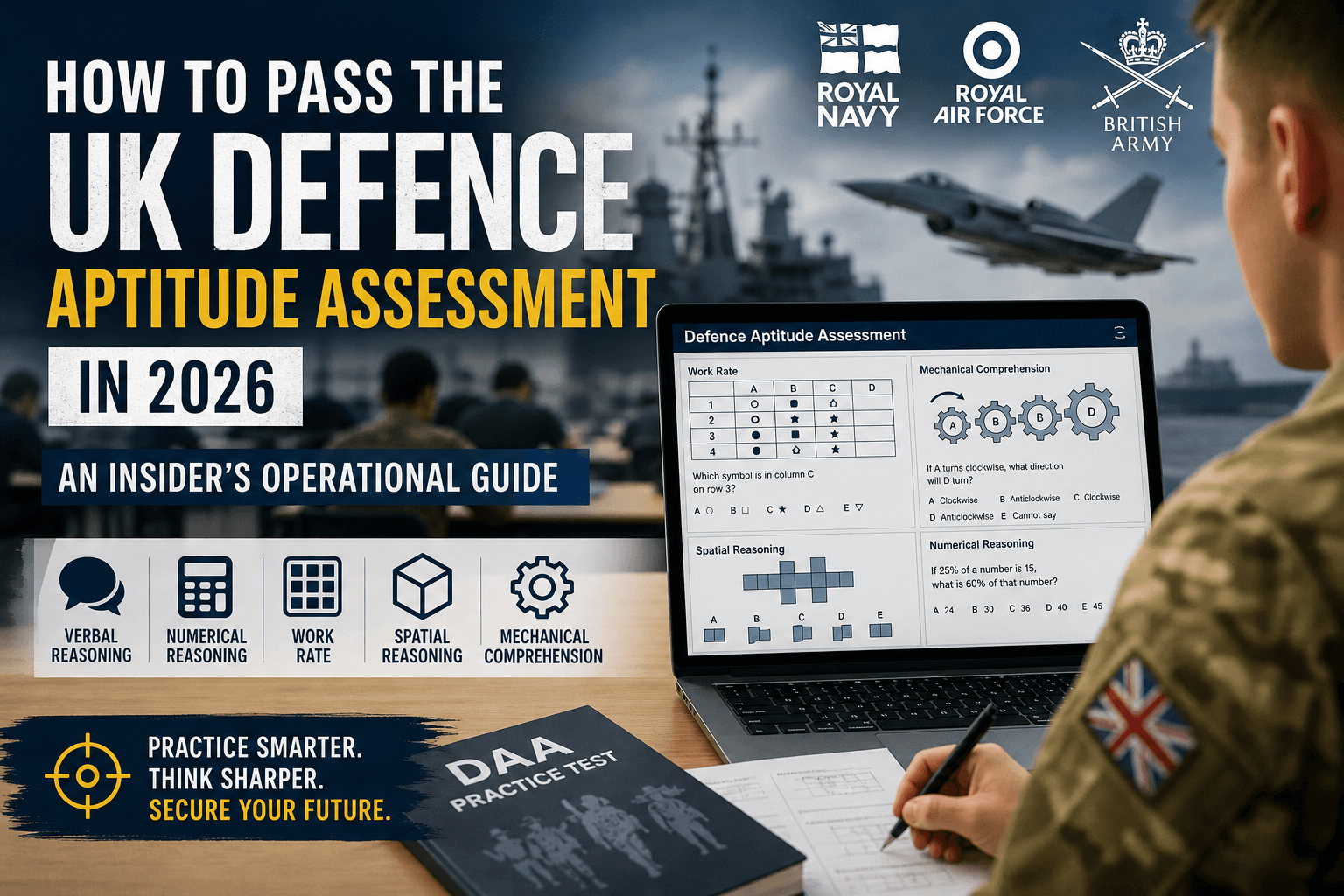
The Defence Aptitude Assessment is divided into several timed sections designed to test different skills required for military roles.
Verbal Reasoning
This section measures how well you understand written information.
Typical tasks include:
- Identifying similar meanings between words
- Completing sentences logically
- Understanding short written passages
Example question:
Choose the word closest in meaning to accurate.
A) Correct
B) Large
C) Fast
D) Heavy
E) Quiet
Numerical Reasoning
The numerical section measures how quickly and accurately you can work with numbers.
Common topics include:
- Basic arithmetic
- Percentages
- Ratios
- Simple word problems
Example question:
A ship travels 120 miles in 4 hours. What is its average speed?
A) 20 mph
B) 25 mph
C) 30 mph
D) 35 mph
E) 40 mph
Correct answer: C) 30 mph
Work Rate
The Work Rate section tests how quickly and accurately you can match coded information.
Candidates must rapidly compare letters, numbers, and symbols within a grid and identify the correct matches.
This section is primarily designed to measure:
- Concentration
- Speed
- Accuracy under time pressure
Work Rate questions are usually the most time-pressured part of the test, so practising beforehand can make a significant difference.
Spatial Reasoning
Spatial reasoning questions assess your ability to mentally manipulate shapes.
Typical tasks include:
- Identifying how shapes fit together
- Rotating objects mentally
- Matching edges of shapes
These questions are particularly relevant for technical and engineering roles in the Royal Navy.
Mechanical Comprehension
Mechanical comprehension questions test your understanding of basic mechanical and physical principles.
Common topics include:
- Gears
- Pulleys
- Levers
- Forces and motion
- Simple machines
- Basic tools and engineering equipment
Example question:
Two gears are connected. If the first gear rotates clockwise, the second gear will rotate:
A) Clockwise
B) Anticlockwise
C) Both directions
D) Faster but same direction
E) It will not move
Correct answer: B) Anticlockwise
How the Royal Navy DAA Is Scored
Your performance in the Defence Aptitude Assessment determines which Royal Navy branches you are eligible to apply for.
Higher-technical roles generally require higher scores.
Typical examples include:
| Royal Navy Branch | Score Requirement |
|---|---|
| Warfare Specialist | Medium |
| Logistics roles | Medium |
| Engineering Technician | High |
| Aircrew roles | Very high |
If your score does not meet the requirement for your chosen role, you may be offered alternative career options within the Royal Navy.
Top 5 Tips to Pass the Royal Navy DAA
1. Practise Under Time Pressure
Most candidates find the biggest challenge is the speed of the test. Timed practice questions help improve your pace.
2. Improve Mental Maths
Quick calculations are essential in the numerical section. Focus on:
- Multiplication tables
- Percentages
- Fractions
- Estimation techniques
3. Learn Basic Mechanical Principles
Understanding how gears, pulleys, and levers work will help you answer mechanical comprehension questions quickly.
4. Practise Pattern Recognition
Spatial and reasoning questions often rely on spotting patterns. Regular practice improves your speed dramatically.
5. Take Full Mock Tests
Full mock tests help simulate the real exam environment and allow you to identify areas where you need improvement.
Candidates who practise beforehand often perform 30–50% better than those who take the test without preparation.
Start Preparing for the Royal Navy DAA
Preparing in advance is one of the best ways to improve your chances of success in the Royal Navy Defence Aptitude Assessment.
At Aptitude Test UK, we provide:
- Royal Navy DAA practice questions
- Mechanical comprehension drills
- Work Rate grid practice
- Full timed mock tests
Start practising today and increase your chances of passing the Royal Navy aptitude test on your first attempt.